Categories
Geometry /Shapes

Proof: Diameter is the Shortest Curve that bisects circular area

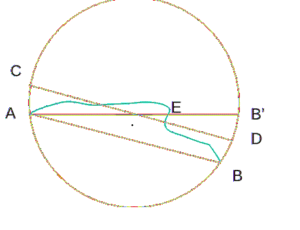
As shown in the figure below: (please scroll down a bit to see the figure) AB’ is one diameter of the circle, and a blue curve from A to B is supposed to bisect the area of the circle. We see from the figure below:

Length of the blue curve AB is greater than: AE + EB = AE + EB’

which is certainly longer than AB’; AB’ is the diameter.

The blue curve is obvious the focus. (Note when blue curve AB is mentioned, we mean the “curved one”: it curves around, not going straight from A to B.) Besides, point E is where the blue curve intersects with CD; and CD is one diameter.

So we have proved the claim that any curve bisecting the circular area got to be longer than the diameter.

Stay with us for one more minute. Let the construction-proof process be revealed to you, as follows.

Referring back to the figure. Let us start from the circle and the blue curve only (imagine all other lines and points disappear; now we draw them step by step). Connect the two endpoints A, B of the blue curve by a line segment AB. Then draw the diameter CD // AB (i.e. line CD is parallel to line AB).

Take point O (the midpoint of CD), and then passing A and O, let another diameter AB’ be drawn.

For completing the proof , two arguments are required:

(1) The blue curve has at least one intersection point with  diameter CD (thinking it: if the blue curve resides at only one side of CD, then that curve cannot divide the circular area evenly into two parts with equal area; therefore, any curves that bisects the circular area must intersects diameter CD). Now suppose the intersection point is E.

(2) B and B’ are symmetric to the diameter CD therefore EB = EB’ (trying justifying it using the property of circles and parallel lines).

The rest of the proof is straightforward (and intuitive).

Categories
Math All Contests Math Contests - Problems and Discussion

Introduction to Canadian Math Contest

Have you heard about the Canadian Math Contests? It is certainly for those talented in math and logic to show their ability, and of course, good opportunities for those who love challenges.

For a student to participate in a contest, talk to the school he attends, or talk to us (Jonah’s Math Corner). Be sure enrolled in a middle school located in Canada (a student has to participate through a school or an agent in the country he/she currently studies at).

Please check the grades eligibility too – if it says grade 9, then all students in grade 10 and higher cannot write that contest. A general rule is students in lower grade are allowed to participate in contests for higher grade, but higher grade students CANNOT write contests for lower-grade.

For students wish to participate and challenge, it worths to have in mind the following Contest series: (apart from the Popular Math Contests – which include Math Kangaroo for grades 1 – 12, all other math contests are for middle school students)

1) Popular Math Contests: Math Kangaroo, started in Europe and becoming popular across world, is organized by Math Kangaroo company. Their are 6 age groups and each group bracket two grades, like grades 1-2, grades 3-4, .. .. According to the organizer’s claim, the purpose of the contest is to challenge students in a playful setting; instead of academic, it aims at developing mental powers and flexibility.

2) Junior math contests (have to be under grade 9 to participate): the most popular is the Gauss contest for grades 7 & 8, organized by U. of Waterloo. Gauss is very popular that some school teachers enrolled all of their students to participate. If you live in Alberta, then both U. of Calgary and U. of Alberta have set up challenges for Junior students.

3) Mid-level and High-school level Contests — the main stage for the middle school math challenge. University of Waterloo has organized 3 series respectively for grade 9, 10 and 11. The contests questions appears typically in multiple-choice format.

Series I: PCF contest: Pascal for grade 9, Cayley for grade 10 and Fermat – for grade 11.

Questions in this series appear in multiple-choice format.

Series II: FGH contest: Fryer – for grade 9, Galois – for grade 10 and Hypatia – for grade 11.

No multiple-choice question. All answers have to be worked out by participants. In any of these series, there will be two types of questions, one will ask participants for answers only, and the other type will ask students to write full solutions. Each contests is 75 minutes long.

Series III: CIMC – Canadian Intermediate Math Contests (for grade 9/10) and CSMC – Canadian Senior Math Contests (for grade 11/12). The format is similar to FGH, however, the level of challenge is in general higher, and students are provided with 2 hours time to answer.

4) Selective Contests for those best talents in math: Canadian Math Society have a challenge series for those who want to participate in Math Olympiad. The first step is the COMC (Canadian Open Math Challenge). It is selective, so only COMC is open to students; all following contests in the series, like CMO (Canadian Math Olympiad) and IMO (International Math Olymiad), are by-invitation ONLY.

5) Other Contests: besides those mentioned, we occasionally will register students in Regional Math League of Canada or US – some contests are online only – save students the cost and time to travel.

Jonah’s math corner can serve as a site to supervise students to write the math contests. If you have any question, just talk to us.
Categories
Math Contests - Problems and Discussion Math Junior (G9 and under)

Sample Questions for Gauss Contests


Questions chosen from previous Gauss contests
Gauss contests are organized by the Centre of Education for
Math and Computing, University of Waterloo


Problem 1

In the addition shown, P and Q each represent single digits, and the sum is 1PP7. What is P + Q?

(A) 9 (B) 12 (C) 14 (D) 15 (E) 13

Problem 2

In the right-angled triangle PQR, we have that PQ = QR. The three segments QS, TU and VW are perpendicular to PR, and the segments ST and UV are perpendicular to QR, as shown. What fraction of triangle PQR is shaded?

(A) 3 ⁄ 16 (B) 3 ⁄ 8 (C) 5 ⁄ 16 (D) 5 ⁄ 32 (E) 7 ⁄ 32

Problem 3

A box contains a total of 400 tickets that come in five colors: blue, green, red, yellow, and orange. The ratio of blue to green to red tickets is 1 : 2 : 4. The ratio of green to yellow to orange tickets is 1 : 3 : 6. What is the smallest number of tickets that must be drawn to ensure that at least 50 tickets of the same colour have been selected?

(A) 50 (B) 246 (C) 148 (D) 196 (E) 115

Problem 4

Greg, Charlize, and Azarah run at different but constant speeds. Each pair ran a race on a track that measured 100 m from start to finish. In the first race, when Azarah crossed the finish line, Charlize was 20 m behind. In the second race, when Charlize crossed the finish line, Greg was 10 m behind. In the third race, when Azarah crossed the finish line, how many metres was Greg behind?

(A) 20 (B) 25 (C) 28 (D) 32 (E) 40

Problem 5

In right-angled, isosceles triangle FGH, segment FH = √̅8. Arc FH is part of the circumference of a circle with centre G and radius GH. The area of the shaded region is

(A) π – 2; (B) 4 π – 2 (C) 4 π – (1 ⁄ 2) √̅8 ; (D) 4 π – 4 (E) π – √̅8

Categories
Numbers

Prime numbers

Prime numbers are those that have 1 (one) and itself as the only two divisors. Examples of primes are 2, 3, 5, 7, 11. None of 4, 6, 9 is a prime since 4 = 2 × 2, 6 = 2 × 3, and 9 = 3 × 3.

If a number greater than one is not a prime, then it is a composite number, and can be factored into the product of primes — called prime factorization. We have given the prime factorization of 4, 6, 9 as above. For a couple of more examples:

12 = 2 × 2 × 3

36 = 2 × 3 × 3 × 3

28 = 2 × 2 × 7

So all natural numbers are divided into three classes: the number 1, the prime numbers, and the composite numbers.

A bonus point: π, besides representing in a circle, the ratio of circumference to diameter, also stands for a special function related to prime numbers. This is described as follows.

Function π(x) — for integer x, represents the number of primes less than or equal (i.e. not exceeding) x.


For example,

π(2) = 1, π(3) = 2, π(10) = 4, π(20) = 8 etc.
[To find why π(10) = 4, recall the 4 prime numbers not exceeding 10: they are 2,3,5, and 7.]

Categories
Algebra Equations (incl. Inequalities) Math Modelling

Pairing up with a Perfect Match

Math starts from the simple and goes a long way.

In this post, we will start from “pairing up” like 1 + 4 = 2 + 3 = 5 but there is a long way to go so that we learn the sets, working on the sets, pairing-up, observing and developing conditions for a perfect pair-up.

Pairing up for a Perfect Match