Categories
Geometry /Shapes

Proof: Diameter is the Shortest Curve that bisects circular area

As shown in the figure below: (please scroll down a bit to see the figure) AB’ is one diameter of the circle, and a blue curve from A to B is supposed to bisect the area of the circle. We see from the figure below:
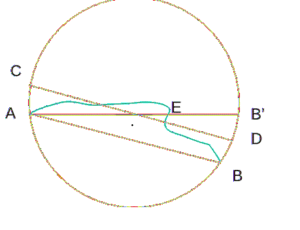
Length of the blue curve AB is greater than: AE + EB = AE + EB’

which is certainly longer than AB’; AB’ is the diameter.

The blue curve is obvious the focus. (Note when blue curve AB is mentioned, we mean the “curved one”: it curves around, not going straight from A to B.) Besides, point E is where the blue curve intersects with CD; and CD is one diameter.

So we have proved the claim that any curve bisecting the circular area got to be longer than the diameter.

Stay with us for one more minute. Let the construction-proof process be revealed to you, as follows.

Referring back to the figure. Let us start from the circle and the blue curve only (imagine all other lines and points disappear; now we draw them step by step). Connect the two endpoints A, B of the blue curve by a line segment AB. Then draw the diameter CD // AB (i.e. line CD is parallel to line AB).

Take point O (the midpoint of CD), and then passing A and O, let another diameter AB’ be drawn.

For completing the proof , two arguments are required:

(1) The blue curve has at least one intersection point with  diameter CD (thinking it: if the blue curve resides at only one side of CD, then that curve cannot divide the circular area evenly into two parts with equal area; therefore, any curves that bisects the circular area must intersects diameter CD). Now suppose the intersection point is E.

(2) B and B’ are symmetric to the diameter CD therefore EB = EB’ (trying justifying it using the property of circles and parallel lines).

The rest of the proof is straightforward (and intuitive).

Categories
Algebra

Irrational Number – Proving the square root of 2 is an irrational number

Yes. We are to claim the irrationality of [pmath size=14] sqrt 2 [/pmath].

We will use proof by contradiction.

Assume that [pmath size=14] sqrt 2 [/pmath] is a rational number. Then by definition of rational numbers, we may write that

[pmath size=12] sqrt 2 = n / m [/pmath]

where n, m are integers.

Squaring on both sides: [pmath size=12] (sqrt 2)^2 = (n / m)^2[/pmath], or

[pmath size=12] 2 = n^2 / m^2 [/pmath]

which leads to [pmath size=12] 2 m^2 = n^2 [/pmath] (*)

Let us show that (*) cannot hold true.

Method 1.

Let [pmath size=12] m = 2^p K, n = 2^q L [/pmath], where p, q are integers, K and L are odd integers.

{If either K or L are even numbers, then factor 2 can be extracted iteratively until an odd number (co-factor) is revealed. }

Bringing m, n in the above forms into [pmath size=12] 2 m^2 = n^2 [/pmath], then:

[pmath size=12] 2 ((2^p) K)^2 = (2^q L)^2 [/pmath]

[pmath size=12] 2^{2p+1} K^2 = 2 ^{2q} L^2 [/pmath] (++)

Let us count the number of 2’s on each side. The l.h.s has (2p+1) of factor 2’s (an odd count of 2), and the r.h.s. has (2q) of 2’s (an even count of 2’s). However, it is well established that for any integer, the prime factorization is unique. Therefore, equation (++) cannot holds. Tracing back, we have to revoke the initial assumption

[pmath size=12] sqrt 2 = n / m [/pmath]

Therefore, number [pmath size=12] sqrt 2 [/pmath] is not a rational number.

Method 2.

Note in [pmath size=12] n^2 = 2 m^2[/pmath], the right hand side is even, so the left side is also even. This implies that n must contain factor 2. Let n = 2 N, then

[pmath size=12] 2 m^2 = (2 N)^2[/pmath] — > [pmath size=12] m^2 = 2 N^2 [/pmath]

where the new equation [pmath size=12] m^2 = 2 N^2 [/pmath] implies that number m must contain factor 2. So each of n, m and N contains factor 2.

This process may be applied in an iterative manner, forever. Consequently, both m and n contains an infinite many factors of 2’s. However, this is not possible as either n or m is a finite number.

You got it?

If you got it, you shall be able to prove that [pmath size=12] sqrt 3 [/pmath] is also irrational (i.e. [pmath size=12] sqrt 3 [/pmath] cannot be written as the ratio of two integers.) How? Just use the same idea, but this time, you need to count the number of 3’s.